
Overview
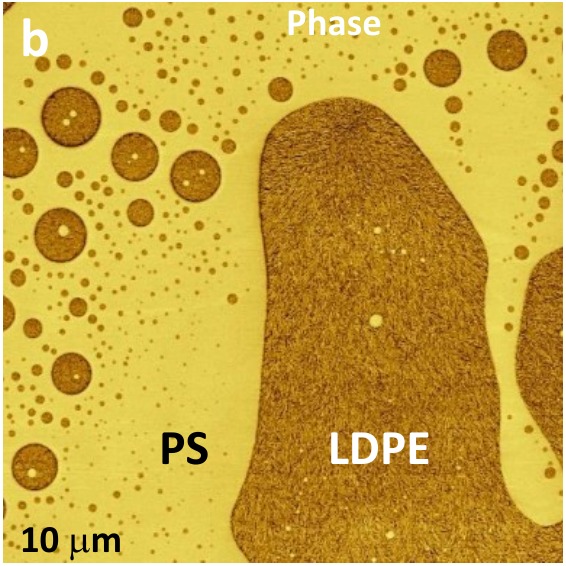
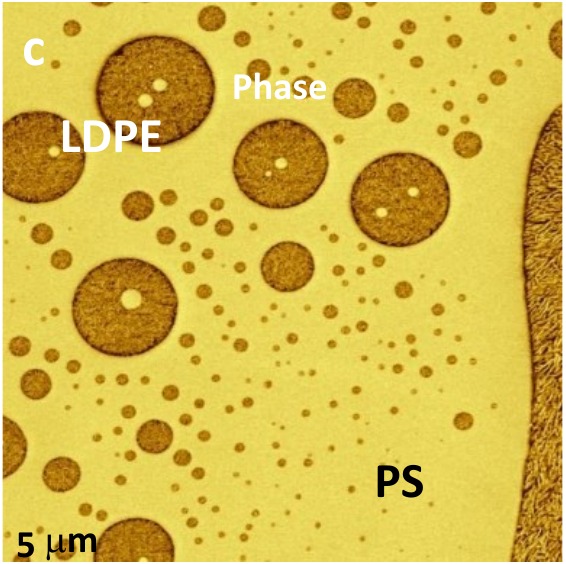
Thin films of an immiscible PS/LDPE blend on Si show domain morphology that is readily imaged in AM-PI (tapping) mode. The guide highlights phase contrast related to elastic-modulus differences and notes that the sample is also handy for elastic-modulus mapping in D-CNT (PeakForce™) mode.
At a glance
| Material | Blend of atactic polystyrene (PS) and low-density polyethylene (LDPE) on Si substrate |
|---|---|
| Typical moduli (guide) | PS ≈ 3.0 GPa; LDPE ≈ 0.2 GPa at room temperature (values stated in the product guide) |
| Thermal notes (guide) | PS glass transition ≈ 100 °C; LDPE melting is discussed near that temperature range |
| Primary AFM uses | AM-PI / tapping height and phase; PeakForce-style modulus mapping practice |
| What this is not | Not presented here as a certified calibration standard or traceable hardness/dimension artifact |
Imaging notes from the guide
- Phase contrast between PS and LDPE becomes clearer at higher tip–sample force (lower set-point relative to free amplitude), as shown in the guide.
- LDPE domains often show crystalline lamellae in phase images; PS regions appear comparatively featureless.
- Heating experiments and recrystallization morphology are illustrated in the guide PDF.
Figures and wording on this page summarize the published product guide. For full discussion, figures, and references, download the PDF.
Sample-specific AFM reports: if you want a lightly processed image report for the sample you receive, ask when requesting a quote. We will confirm availability for that order.