
Overview
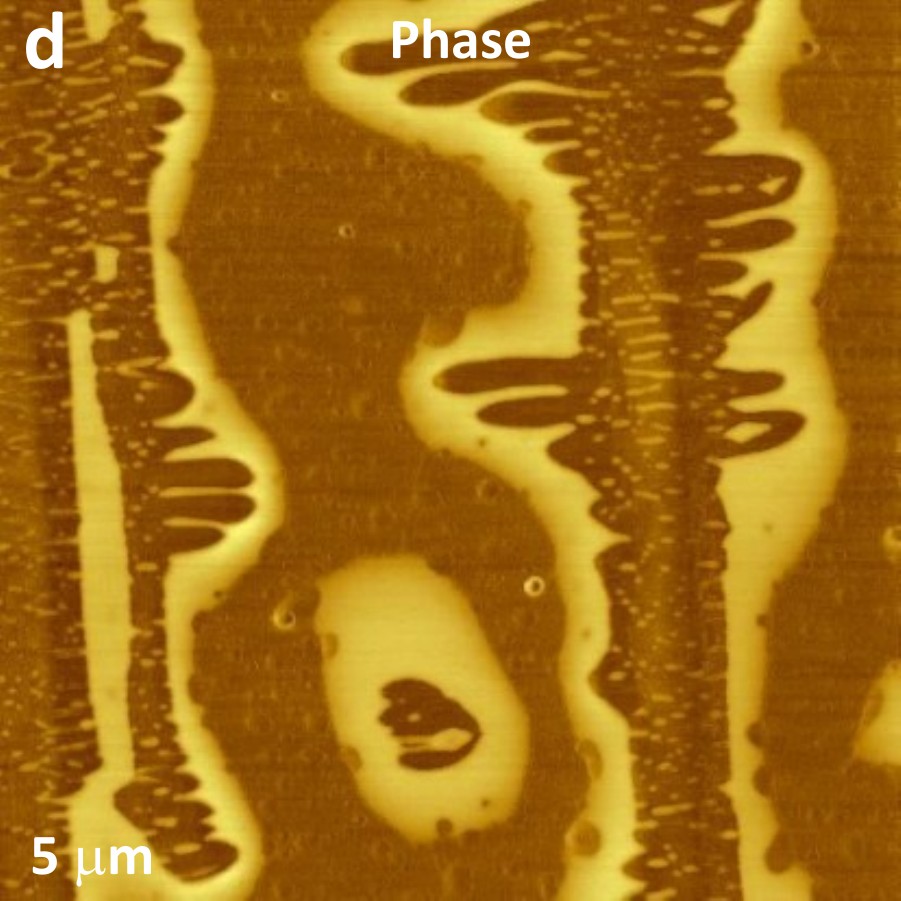
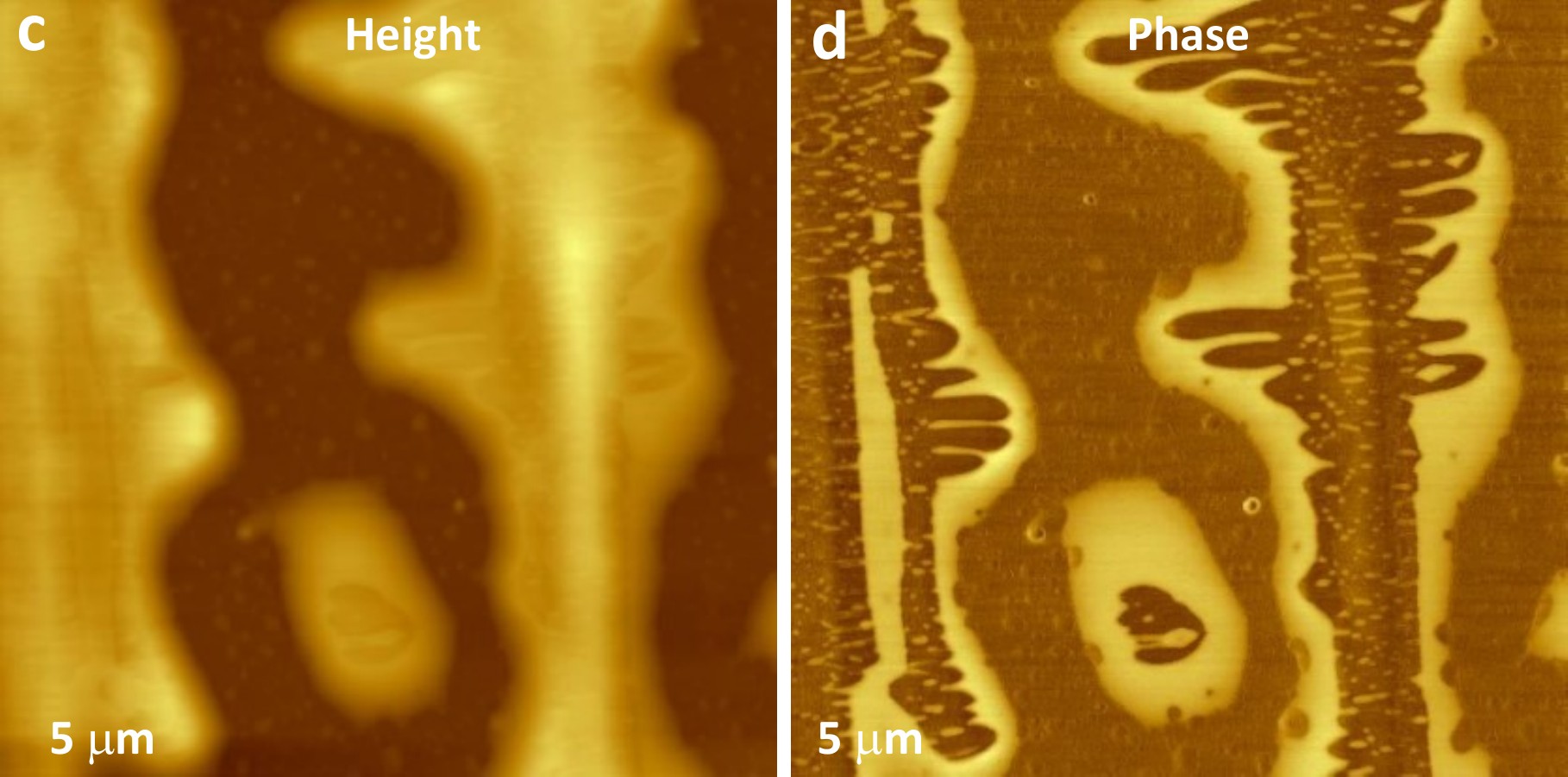
PDES is a soft, non-polar flexible-chain polymer with crystalline and mesomorphic phases between about −70 °C and +60 °C. A common AFM preparation is uniaxial rubbing on a smooth Si wafer, producing oriented strands with lamellar aggregates.
At a glance
| Material | Poly(diethylsiloxane) [-Si(C₂H₅)₂-O-]ₙ on Si |
|---|---|
| Preparation (guide) | Uniaxial rubbing on smooth substrate (e.g., Si wafer) |
| Primary AFM uses | AM-PI (tapping) height and phase; temperature-dependent morphology |
| Notable contrast | Phase contrast helps distinguish crystalline/mesomorphic lamellar aggregates from amorphous PDES and bare substrate |
Imaging notes from the guide
- At room temperature, rubbed samples show oriented strands; cigar-like blocks are lamellar aggregates oriented perpendicular to the rubbing direction.
- The guide shows morphology changes on heating through isotropization and on cooling as lamellar aggregates re-form.
- Phase contrast depends strongly on tip–sample force (probe spring constant, free and set-point amplitudes).
Figures and wording on this page summarize the published product guide. For full discussion, figures, and references, download the PDF.
Sample-specific AFM reports: if you want a lightly processed image report for the sample you receive, ask when requesting a quote. We will confirm availability for that order.